

I am passionate about many things, but car seat safety is not one of them. Fortunately, I have a few car seat-enthusiast friends from whom I have learned much. They have taught me four important lessons:
1. “I didn’t ride in a car seat until I was 7 and I’m still alive!” is a stupid argument.
Your parents probably did a lot of things that would be unthinkable to you. (I don’t remember eating kale ONCE growing up — thanks a lot, mom and dad!) Still, you hear this argument about all kinds of things:
- “I wasn’t breastfed and I turned out fine!”
- “I never wore a bike helmet and I don’t have a traumatic brain injury!”
- “My mother smoked two packs a day when she was pregnant, and I’m perfectly healthy!”
The fact is, motor vehicle crashes are the leading cause of death for children 1-4 years old. Most studies agree that car seats significantly reduce both injuries and death for babies and children. And bonus, putting your kid in a car seat takes about one extra minute of your time (as long as she isn’t kicking and screaming and refusing to bend at the waist). That’s a pretty big safety payoff.
You might also be interested to know WHY we humans are prone to this error in judgement. There are two major biases at play here, according to economist Daniel Kahneman (have I mentioned that I love his book Thinking, Fast and Slow? Seriously, I worked it into a post about Ke$ha).
The first is the availability bias: if we can’t recall a child we know dying in a car crash, or haven’t heard about a child being killed recently, we assume that this event is quite rare, and therefore nothing to worry about. This same bias is the reason most of us are terrified of our child being kidnapped, even though it’s EXTREMELY rare. News programs ensure that we are easily able to recall a recent kidnapping, and therefore (wrongly) assume it’s quite common.
The second bias we’re guilty of is called anchoring: in this case, the “anchor” is the average age of car seat use among your peers and family members. If most people you know turn their baby’s car seat to forward-facing at age 1, then keeping your baby rear-facing until age 2 will seem extreme. Likewise, a child in a booster seat at age 8 seems ridiculously old when there wasn’t even such a product when you were younger. (This is the bias at play when people start tossing around phrases like “Why don’t you just bubble-wrap the kid?”)
How SHOULD we make decisions about car seat use? Consider a technique I like to call evidence-based parenting: find data from trusted sources, and make decisions accordingly. Also, stop thinking of each stage as a step up: as my friend Jen says, “Remember that each change (rear-facing to forward facing, car seat to booster seat to seat belt) is actually a step DOWN in safety.”
2. You probably installed your car seat wrong.
One study found that 72% of car seats and booster seats were “misused in a way that could be expected to increase a child’s risk of injury during a crash.” Some of the most common errors when installing a car seat are:
- It’s too loose: the base (for an infant seat) or seat should not move more than an inch from side to side or front to back. You will probably have to put your knee in the seat and push down on it while pulling on the seat belt or latch straps to get it tight enough.
- You didn’t lock the seat belt: If you’re using the seat belt instead of the LATCH system, make sure the seat belt is locked. Check your car’s owner’s manual if you don’t know how to do this.
- The angle is wrong: this is particularly dangerous when an infant seat is tilted too far forward, resulting in baby’s heavy head tilting forward and making it difficult for her to breathe. To fix this, use a cut-up pool noodle or tightly rolled towel under the car seat where baby’s feet rest.
- You’re not using the top tether, or it’s not hooked in the right place: you should use the top tether with a forward-facing seat if at all possible. Make sure it’s hooked in the right place according to your car’s owner’s manual.
- You’re using both the LATCH hooks AND the seat belt
- The seat belt is routed wrong: check your car seat’s manual to make sure you know where to thread the seat belt, noting that it’s different depending on whether the seat is forward- or rear-facing.
3. You probably don’t have the straps tight enough.
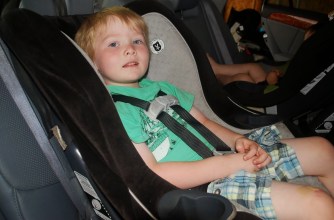
The straps should be tight enough for the “pinch test”: once your child is buckled in, try to pinch the fabric of the harness straps between your fingers. If you can do so, the straps are too loose, which may result in too much excursion or even ejection from the seat. Be sure to tighten up the straps every time you put your kid in their seat, and, for the LOVE, move the chest clip up to their armpits where it belongs. Finally, be aware that bulky winter coats may make the straps appear tight enough, but will compress in a crash. There are several options to keep your kid warm AND safe here in the frigid north:
- Use a car seat cover with your infant seat instead of putting baby in a bulky coat or snowsuit (and consider steering clear of covers like the Bundle Me that put an additional layer between your baby and the car seat). Take a look at the JJ Cole Car Seat Cover or the Cozy Cover.
- Have your kid wear his coat to the car, then take it off, buckle him in, and put the coat on him backwards
- Buy a car seat-friendly coat (see here for how to test)
- Buy a car seat coat or poncho, which are designed to be worn without interfering with the safety of the car seat
- Have your kid wear a thinner fleece jacket or sweatshirt instead of a coat for car rides.
- If you don’t have auto-start in your car, consider getting it. Because SAFETY.
One more thing: once in a while, make sure to check that the harness straps are threaded through the correct spot in the shell: when rear-facing, straps should be at or just below the shoulders; when forward-facing, straps should be at or just above the shoulders. Find other tips for correct installation and use here.
4. The laws in your state may be different than the laws of physics. Consider going with the laws of physics.
In North Dakota, babies are required by law to be rear-facing in a car seat until age one AND 20 pounds (which means both a 21-pound 6-month old AND an 18-pound 2-year-old should still be rear-facing). Toddlers must be in a car seat until they reach the upper weight limit of their car seat (at least 30-35 pounds, but some seats now go way past that). Children who have outgrown their car seat must ride in a booster seat (with both a lap and shoulder belt) until at least age 7.
The laws of physics are a little more stringent. If you have a baby or toddler, you may have heard that the American Academy of Pediatrics and many other health and safety organizations are now recommending that children remain rear-facing until at least 2 years of age, or until the rear-facing limit of their car seat (which may mean 3 or 4 years of rear-facing possibility — that 2-year recommendation is the bare minimum). Babies and toddlers are significantly safer when rear-facing, reducing their risk of injury in a crash by at least a factor of five. Be aware that there has been no evidence of increased leg injuries with extended rear-facing, and that most children will happily fold their legs or put them up on the seat back. They may even be more comfortable that way compared to their legs dangling when forward-facing.
Once they’re forward-facing, children are safest in a 5-point harness: just leave them until they outgrow the weight/height limit of their seat (periodically checking the height of the straps to make sure they’re at or just above their shoulders). The next step down in safety is a booster seat. The shoulder belt of your car’s seat belt is made to cross (that’s right!) at the shoulder. If the shoulder belt is crossing at your kid’s neck, they should be in a booster seat. They should remain in a booster until the seat belt fits them properly, which is about 4’9 in height (about the height of an average 11-year-old).
…………………………………………
I admit, I’m just as prone to bias as the next person, so I have not always followed the examples of my crazy well-informed friends. However, after researching this article, I realized my reasons for ignoring the guidelines were pretty dumb:
- I wouldn’t have to listen to my daughter complain that her friend doesn’t ride in a booster
- I would be able to get rid of one car seat (I really love to get rid of stuff)
- The two little boys could face the same way so they can watch a movie together on long car trips
- Buckling the little ones in their car seats is a pain
- We probably won’t get in a car accident anyway
So I put my 8-year-old back in a booster seat (she’s 4’4, well below the height for proper seat belt functionality). Also, my 4-year-old is well below the upper height and weight limits for his car seat, so he’ll stay in his 5-point harness for the foreseeable future. And my 20-month-old will be looking backward for a couple more years. I guess they’ll have to take turns with the Kindle on long car trips. Poor kids.
 Paisley Doula